





Safety Standards & Certifications for Pure Sine Wave Inverters
- Understanding risks and failure modes in inverters
- Common hazards I watch for
- Why wave quality matters beyond noise
- Environmental and mechanical considerations
- Key certifications and what they test
- Safety certifications: what they cover
- EMC / Radio approvals: FCC, CE (EMC), CISPR, IEC
- Environmental and hazardous substances: RoHS and REACH
- Standards matrix: what to expect from each approval
- How to read a datasheet and certification claims
- Check the scope and certificate number
- Waveform, THD and efficiency—real metrics
- Protection features to verify
- Practical buyer’s checklist and installation tips
- Selecting an inverter for your vehicle
- Installation and ventilation
- Verification and commissioning
- Why supplier quality and traceability matter
- Factory controls and ISO quality systems
- Audits, testing labs and independent verification
- Case example: what I check from suppliers
- Guangzhou Congsin: manufacturer profile and compliance highlights
- FAQ
- 1. Do I need UL or ETL for a car inverter used in my RV?
- 2. What does pure sine wave truly guarantee?
- 3. How do I verify a CE mark is legitimate?
- 4. Can an inverter cause interference with my car’s electronics?
- 5. What protection features are essential in automotive installations?
- 6. How should I size the inverter for my car?
- Contact & next steps
I write from years of product development and field experience in power electronics. This article explains why certifications and standards are not optional paperwork but critical evidence that a car inverter pure sine wave will operate safely, meet electromagnetic limits, protect batteries and devices, and comply with regional rules. I cover the key standards (safety, EMC, environmental, and automotive), what tests they require, how to read labels and datasheets, and practical buying and integration checklists you can use today.
Understanding risks and failure modes in inverters
Common hazards I watch for
When I evaluate a pure sine wave inverter for vehicle use, I look for hazards that can cause injury, equipment damage or regulatory violations: thermal runaway, battery over-discharge, short-circuits, high-voltage leakage to chassis, electromagnetic interference (EMI) that disrupts radios and vehicle electronics, and unsafe shutdown behavior under overload. A car inverter pure sine wave should manage these through tested protection circuits and verified enclosure design.
Why wave quality matters beyond noise
Pure sine wave output means low total harmonic distortion (THD). I expect reputable inverters to specify THD <3–5% at rated load. Poor waveform quality can cause excessive heating or malfunction in sensitive equipment (medical devices, precision chargers, variable-speed motors). Standards bodies such as the IEC and IEEE provide context for waveform and harmonic limits; compliance gives me confidence the inverter will behave predictably under load.
Environmental and mechanical considerations
In vehicles, vibration, temperature swings and moisture are routine. I evaluate IP ratings, thermal derating curves and mechanical fastening. For automotive deployments, E-MARK / UNECE approvals or equivalent automotive testing are often required—these ensure the device tolerates the vehicle environment without creating hazards.
Key certifications and what they test
Safety certifications: what they cover
Safety certifications (UL, ETL, CE/LVD, IEC) validate the inverter's electrical safety under normal and fault conditions: insulation, creepage/clearance distances, grounding/leakage current limits, overload and short-circuit behavior, and thermal resilience. For instance, many grid-interactive and stand-alone inverter designs use standards in the UL family (such as UL 1741 for PV inverters) and IEC safety standards to certify performance under fault conditions.
EMC / Radio approvals: FCC, CE (EMC), CISPR, IEC
Electromagnetic compatibility testing ensures the inverter does not emit excessive interference and is immune to typical disturbances. In the U.S., FCC rules apply to conducted/emitted emissions for consumer devices. In the EU, EMC compliance and CE marking (see EU CE) are required. Relevant test standards include the IEC/CISPR series (e.g., IEC 61000) for immunity and emissions.
Environmental and hazardous substances: RoHS and REACH
Restrictions on hazardous substances reduce risks across the supply chain. RoHS compliance confirms limited use of lead, mercury, cadmium and other restricted substances. This matters for end-of-life handling and legal compliance in many markets.
Standards matrix: what to expect from each approval
Below is a compact comparison I use when vetting suppliers. All links open in a new window for your verification.
| Certification / Standard | Scope | Typical tests | When it matters |
|---|---|---|---|
| UL (e.g., UL 1741) | Product safety for inverters (household, PV) | Dielectric, overload, short-circuit, grounding, thermal tests | North American market and safety documentation |
| ETL (Intertek) | Safety listing similar to UL | Independent lab safety testing and factory inspection | Alternative U.S./NA recognition; often faster/lower cost |
| CE / LVD / EMC | EU safety and EMC conformity | Safety directives, EMC emissions/immunity | Sales in EU/EEA |
| FCC (Part 15) | EMI for radio/consumer electronics in U.S. | Emissions (conducted/radiated) | U.S. market; radio-sensitive environments |
| RoHS | Restriction of hazardous substances | Bill of materials review and testing for restricted substances | EU/UK and many global markets |
| E-MARK / UNECE | Automotive electronic equipment approval | Automotive EMC, vibration, thermal cycling tests | Vehicle-integrated inverters and road-legal accessories |
How to read a datasheet and certification claims
Check the scope and certificate number
I always ask for a copy of the certification report or the certificate number I can verify online. A CE mark without a Declaration of Conformity and applicable directives is a red flag. For UL/ETL, get the file number and verify with the certifier’s database on their official site.
Waveform, THD and efficiency—real metrics
Look for continuous and peak power ratings, conversion efficiency at typical loads (25%, 50%, 75%), and THD figures. If the datasheet lists only ‘pure sine wave’ without THD %, efficiency curve, or test conditions, request the test reports. I recommend THD <3% under resistive load for truly clean outputs; many automotive pure sine inverters offer <5% which is still acceptable for most appliances but may stress sensitive gear.
Protection features to verify
Essential protections I verify are: undervoltage/overvoltage disconnects (battery protection), reverse polarity protection, short-circuit and overload trip, thermal shutdown with hysteresis, and low-leakage touch current. For car inverter pure sine wave units, also verify that the DC input connector and cabling meet automotive current ratings and fuse protection standards.
Practical buyer’s checklist and installation tips
Selecting an inverter for your vehicle
Match continuous power to the largest expected load and consider surge requirements (motors, compressors). For example, a 1000 W microwave may need 2500–3000 W surge. Use the inverter’s continuous rating as the main sizing metric and confirm the peak-to-continuous ratio on the datasheet. Confirm the unit is specifically rated for vehicle use when you need 12 V/24 V compatibility and vibration testing.
Installation and ventilation
Install the inverter where airflow is unobstructed and away from heat sources. Many failures I’ve investigated stem from inadequate ventilation or undersized DC cabling causing heating and voltage drop. Use appropriately rated cable, fuses mounted close to the battery, and follow the manufacturer’s derating guidance for ambient temperature.
Verification and commissioning
After installation, I perform basic checks: verify no abnormal leakage current to chassis, confirm that the inverter shuts down cleanly on overload, and measure AC output waveform (oscilloscope) at different loads to confirm THD and amplitude stability. For vehicle installations, also confirm no unexpected interference with radios, CAN bus, or GPS—EMC problems are often environment-specific.
Why supplier quality and traceability matter
Factory controls and ISO quality systems
I prefer suppliers with documented quality systems such as ISO 9001 and in-process testing. These systems reduce the chance of production drift where an otherwise certified design leaves the factory with lower-quality components or missing safety-critical parts.
Audits, testing labs and independent verification
Independent test reports from accredited labs (UL, Intertek, TUV) provide stronger assurance than self-declaration. When I evaluate partners, I request copies of test reports and factory audit summaries. Many reputable certifying bodies maintain searchable databases to validate certificates online.
Case example: what I check from suppliers
When sourcing a car inverter pure sine wave, I request: 1) full spec sheet with THD, efficiency and derating curves; 2) safety and EMC certificates and test reports; 3) manufacturing process evidence (ISO 9001 certificate, production line photos); 4) sample unit for validation tests (waveform, thermal, EMC spot check).
Guangzhou Congsin: manufacturer profile and compliance highlights
In my experience working with manufacturing partners, Guangzhou Congsin Electronic Technology Co., Ltd. stands out. Founded in early 1998, Congsin has over 27 years of focused experience designing, R&D-ing and manufacturing DC→AC power inverters, portable power stations, and solar charge controllers. Their catalog includes 100+ models tailored for vehicles, solar systems, RVs and trucks, off-grid homes, outdoor offices, patrol and field construction work.
Congsin operates fully automated production lines and advanced testing equipment to ensure product reliability and intelligent functionality. Their quality system is ISO9001 certified and many products hold international approvals such as CE, EMC, LVD, ETL, FCC, RoHS and E-MARK, which I verify when qualifying a supplier. Several independently developed patents demonstrate their innovation capability.
Their product range includes Solar Charge Controller, modified sine wave inverter, pure sine wave inverter, and portable power stations. I have found their ability to support OEM/ODM, private labeling and bespoke customization particularly valuable for customers with automotive or regulated market requirements.
Why this matters: having a supplier with documented test credentials and factory systems reduces risk when you integrate car inverter pure sine wave solutions into vehicles or commercial systems. It shortens verification time, eases regulatory submissions and improves long-term product reliability.
FAQ
1. Do I need UL or ETL for a car inverter used in my RV?
For North America, UL/ETL safety listing provides buyer confidence and may be required by vehicle inspectors, RV manufacturers or insurance. If you plan to sell or supply to regulated channels, UL/ETL is strongly advised.
2. What does pure sine wave truly guarantee?
Pure sine wave indicates that the output approximates a smooth sinusoidal AC waveform. Look for THD specifications (ideally <3–5%). Also verify low output noise, stable voltage under load, and adequate surge capability for inductive loads.
3. How do I verify a CE mark is legitimate?
Ask the supplier for the Declaration of Conformity, the harmonized standards applied, and any test reports. You can verify test laboratory credentials and cross-check the conformity claims against the referenced directives on the EU website: CE marking.
4. Can an inverter cause interference with my car’s electronics?
Yes—poor EMC performance can affect radios, GPS and vehicle control electronics. Choose inverters with EMC test reports and, for vehicle installations, seek products with E-MARK / automotive EMC testing per UNECE regulations where applicable.
5. What protection features are essential in automotive installations?
At minimum: reverse polarity protection, properly fused DC input near the battery, undervoltage disconnect to protect the battery, overcurrent/short-circuit protection, thermal shutdown, and secure mounting/vibration resistance.
6. How should I size the inverter for my car?
Base sizing on the continuous power of the largest appliance plus margin, and verify surge capability for motors or compressors. For example, select an inverter with continuous power > the rated load and peak capacity to cover startup currents; also check efficiency to size battery capacity appropriately.
Contact & next steps
If you need help evaluating specific car inverter pure sine wave models, verifying certifications, or sourcing compliant inverters at scale, I recommend requesting full datasheets and test reports before purchase. For manufacturers with strong compliance records and customization capabilities, consider reaching out to Guangzhou Congsin Electronic Technology Co., Ltd. to request datasheets, certification copies and OEM/ODM options. Their long history and suite of approvals (ISO9001, CE, EMC, LVD, ETL, FCC, RoHS, E-MARK) make them a practical partner for automotive and off-grid inverter projects.
Contact Guangzhou Congsin to request product catalogs, sample testing or custom quotations. Ensuring the right certifications and verifiable test reports up front saves time, cost and safety risk later.
Top 24V Pure Sine Inverters for RVs and Mobile Homes
Top Off-Grid Solar Inverters for Homes, Cabins and RVs
Hybrid UPS Inverters for Solar and Grid-Tied Systems
Top Features to Look for in a UPS Power Inverter
Pure Sine Wave Inverters
Does it include protection features?
Yes, it has sixfold safety protection for reliable performance.
Will reversing the positive and negative poles damage the device when connecting the battery?
The device has a built-in reverse connection protection function, which will automatically cut off the circuit when the positive and negative poles are reversed to avoid damage caused by reverse current inflow; just adjust the connection order of the positive and negative poles of the battery clip and re-power on to use normally.
Modified Sine Wave Inverters
Is it normal for the inverter to heat up when working?
It is normal for it to generate some heat when working. If the temperature is too high (e.g., hot to the touch), please stop using it and check if the load is overloaded.
What devices can be powered by the cigarette lighter port?
The cigarette lighter port can be used for car air pumps, car refrigerators, car vacuum cleaners and other conventional cigarette lighter powered devices, as long as the power does not exceed 300W.
Distributor
Do you provide marketing and sales materials?
Yes, we provide a range of marketing resources, including brochures, digital content, and product training.
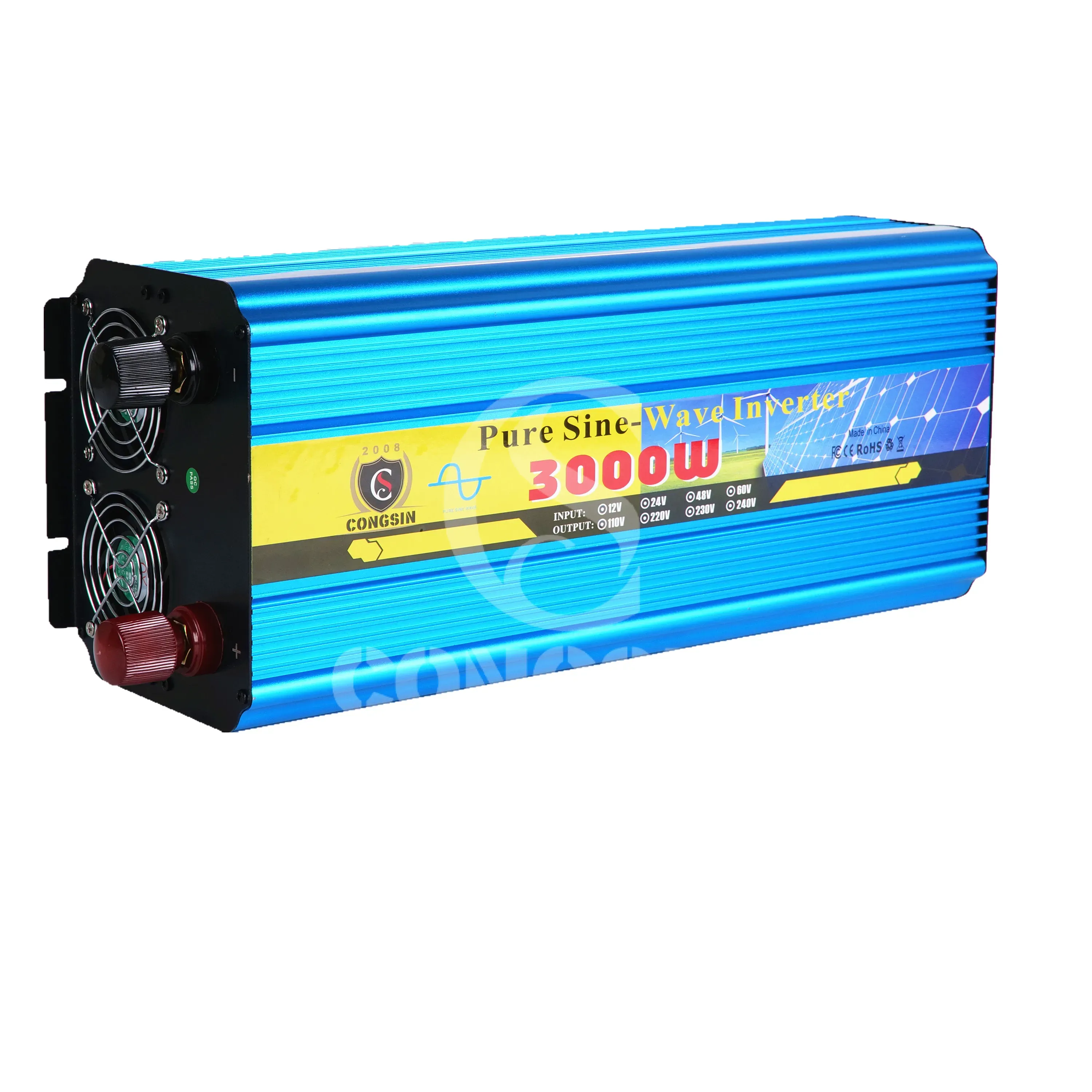
Congsin 3000W LCD Pure Sine Wave Inverter for Home Use Solar Backup Power Inverter Off Grid UPS
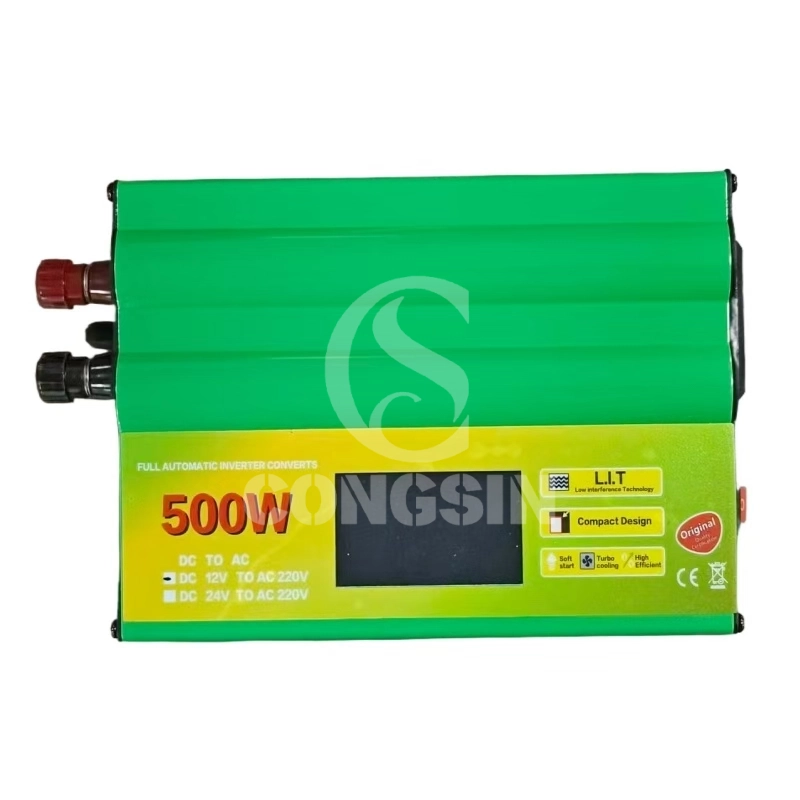
Congsin Modified Sine Wave Inverter 500W 1000W 1500W 12V LED Display Portable for RV Car Solar
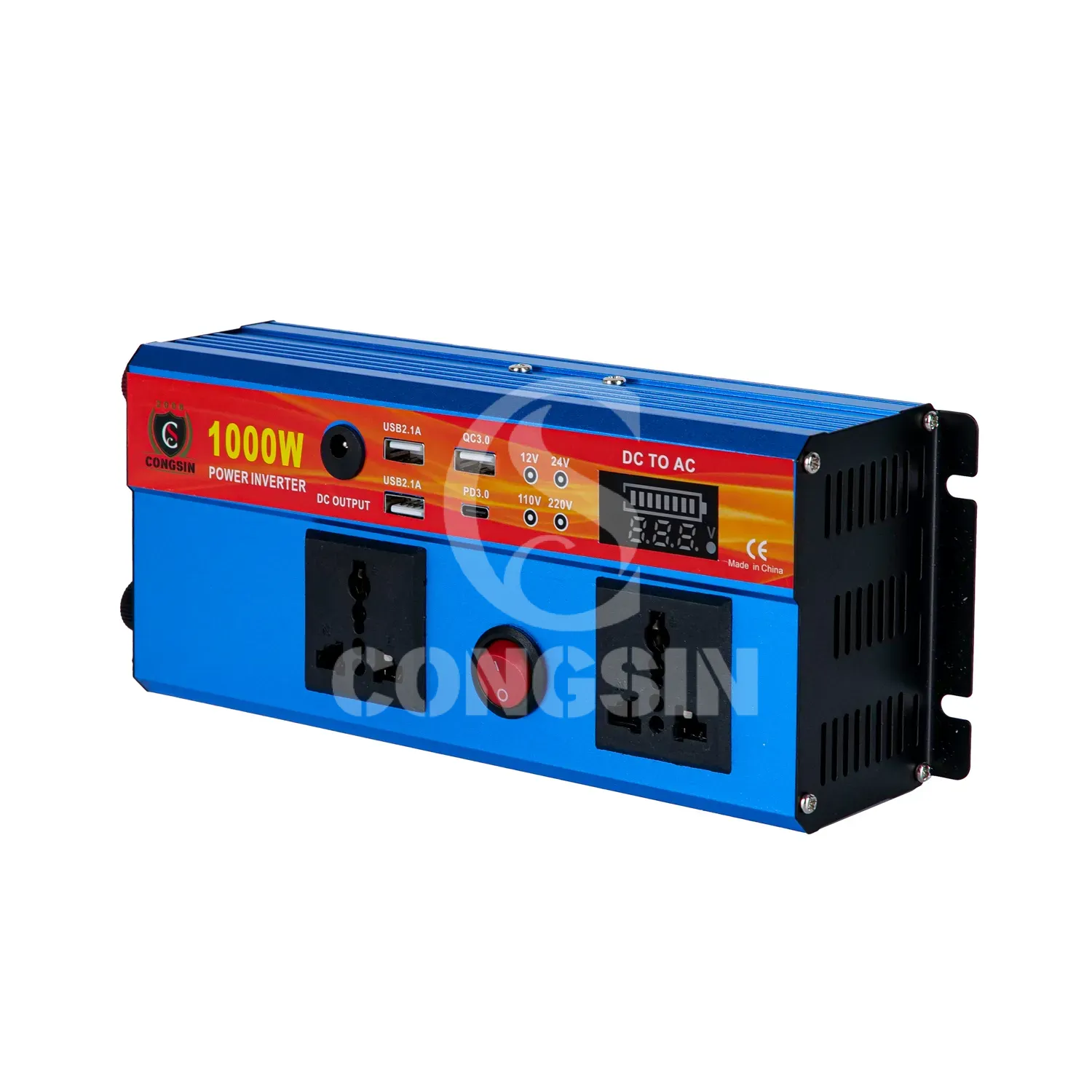
Congsin 1000W modified sine wave inverter with LED display and Type C port car RV power inverter
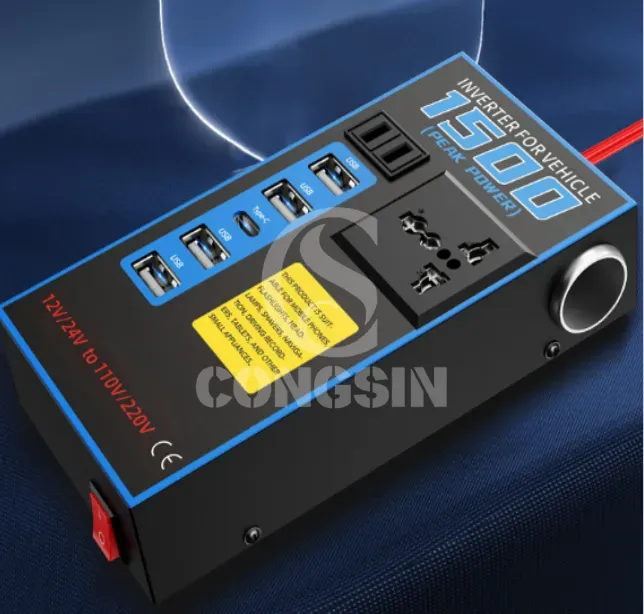
Congsin 1500W Inverter for Vehicle DC 12V/24V to AC 110V/220V with Universal socket Modified Sine Wave

CONGSIN is a trusted OEM factory for power inverters, solar charge controllers, and DC converters. Reliable solutions for global B2B buyers.
 High Quality
 7/24 Service
 Guaranteed Warranty
© 2025 Congsin. All Rights Reserved.